How Much Sleep Kids Need & What Time Kids Go To Sleep During A Child Bedtime Routine
Published on
April 22, 2026
Author
Claudia Fournier
Project Writer | As a devoted writer at ThinkHealth and Wellness, Claudia shares evidence-based insights into natural health, providing balanced reviews of products and promoting a holistic lifestyle. Her creativity shines through in health narratives, and she brings diverse cultural perspectives to the wellness landscape. Claudia is committed to combating health misinformation, ensuring ThinkHealth and Wellness remains a trusted source for reliable and well-researched content.
Can music and movement help fine motor skills?
Yes—finger plays, clapping games, and dance routines that use hand gestures all help. Combine rhythm and repetition for deeper learning.
How can educators encourage home practice?
Send home simple activity ideas, kits, or worksheets. Offer short instructions and encourage family involvement. Regular practice builds lasting progress.
What crafts are best for fine motor practice?
Try origami, sticker scenes, stringing pasta, or painting with Q-tips. Crafts that use small pieces build precision and control.
"What time should my kid actually go to bed?" If you've typed that into a search bar at 9 p.m. while your child is still bouncing off the walls, you are not alone. It is one of the most common questions parents ask, and the honest answer is: it depends. There is no single bedtime that works for every child, because the right bedtime is not a number on a clock — it is a calculation based on how much sleep your child needs for their age and what time they need to wake up the next morning.
Sleep needs change as children grow. A toddler napping twice a day has a very different bedtime than a school-age child preparing for a 6:30 a.m. alarm. Summer schedules, daycare routines, extracurriculars, and nap transitions all have a real effect on when kids go to sleep. The goal is not to find a rigid bedtime and stick to it forever — it is to build a consistent bedtime routine that reflects your child's actual sleep needs at every stage.
This guide covers how much sleep kids need by age, how to calculate a realistic bedtime, signs that your child is not getting enough sleep, and simple healthy sleep habits that support better rest year-round.
Why Bedtime Matters More Than Parents Often Realize
Sleep is one of the most powerful tools for children's health and development. During sleep, the brain consolidates memory, processes emotions, and clears out metabolic waste. Growth hormones are released primarily during deep sleep, which means that when kids do not get the sleep they need, the effects go far beyond next-day grumpiness.
Poor or insufficient sleep in children is linked to difficulties with attention, learning, and emotional regulation. It can affect how a child performs in school, how they manage frustration, and even how their immune system functions. For parents, this is an important reminder: bedtime is not just about convenience or getting a quiet evening. It is a direct investment in how well your child will function the very next day.
The American Academy of Sleep Medicine (AASM) and the consensus statement of the American Academy of Pediatrics both emphasize that children who consistently get the recommended amount of sleep tend to have better attention spans, healthier weight, improved mood, and stronger mental health outcomes. Experts agree: kids need their sleep, and parents have a meaningful role in making sure they get it.
How Much Sleep Do Kids Need? An Age-by-Age Breakdown
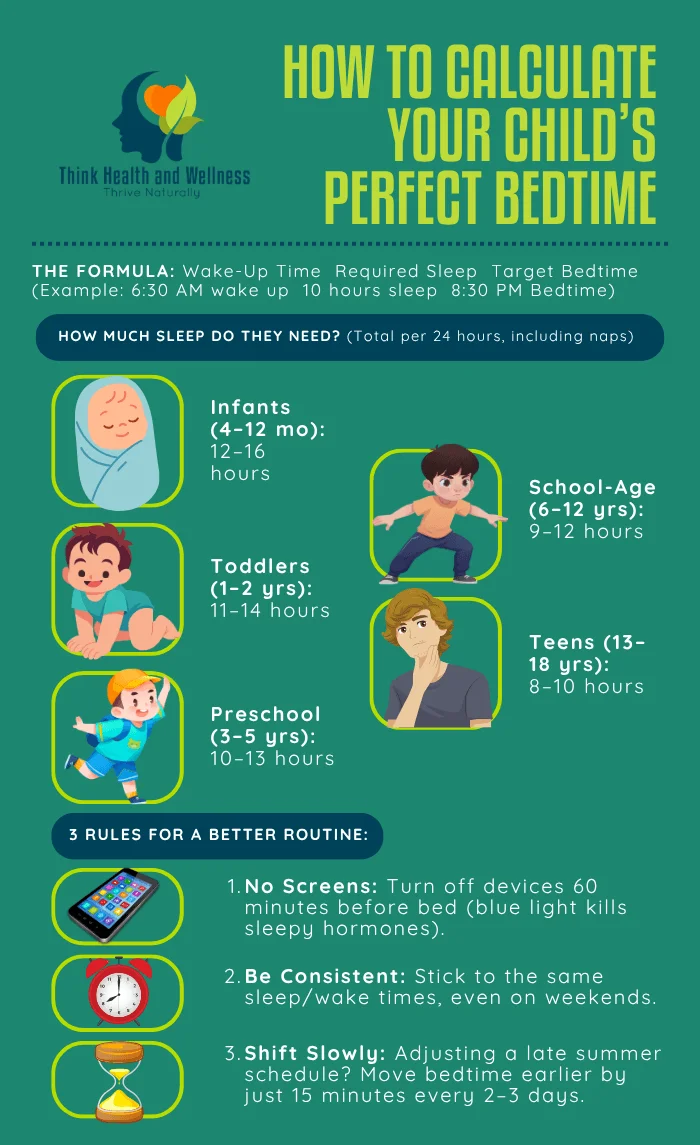
The academy of sleep medicine recommends the following sleep duration ranges for children per 24-hour period, including naps where applicable:
Infants (4–12 months): 12–16 hours
Toddlers (1–2 years): 11–14 hours
Preschoolers (3–5 years): 10–13 hours
School-age children (6–12 years): 9–12 hours
Teenagers (13–18 years): 8–10 hours
Newborn sleep varies more widely and is less predictable, which is why the focus of this guide starts from infancy onward. These ranges include nighttime sleep plus any daytime naps your child still takes. Knowing the recommended hours of sleep for your child's age group is the first step to figuring out a realistic bedtime.
How to Calculate Bedtime: Start with Wake-Up Time and Count Backward
Here is the most practical approach to answering the bedtime question for your specific child: start with their required wake-up time, then count backward by the recommended hours of sleep for their age. This working-backward method is the foundation of setting an appropriate bedtime, and it is far more useful than picking a number out of thin air.
For example, if your school-age child needs to be up at 6:30 a.m. for the school day, and children in their age group need 9–12 hours of sleep, then bedtime should fall somewhere between 6:30 p.m. (for 12 hours) and 9:30 p.m. (for 9 hours). Most parents will find that a target of 10–11 hours puts bedtime somewhere around 7:30–8:30 p.m. — a range that makes sense for a typical school week schedule.
If your child wakes at 7:00 a.m. instead, shift those windows by 30 minutes and you get 7:00–8:00 p.m. as the practical bedtime range for a well-rested child. The exact window will depend on your child's natural sleep patterns, how quickly they fall asleep once in bed, and whether they still nap during the day.
This approach keeps bedtime flexible enough to account for real family life, while still keeping get the sleep they need as the clear priority.
Bedtimes for Kids by Age Group: Practical Parent Guidance
Here is a closer look at bedtimes for kids across different age groups, based on typical wake-up times and recommended sleep duration:
1 Year Old (Toddlers, 1–2 years)
At this age, most children still nap once or twice daily and need 11–14 hours total sleep. If your 1 year old wakes at 7:00 a.m. and naps for 1.5–2 hours during the day, a nighttime bedtime of around 7:00–8:00 p.m. is appropriate. Losing a nap or shortening nap time may mean moving bedtime earlier, not later.
Preschoolers (3–5 years)
This is often a transitional age where nap needs start to fade. The recommended amount of sleep is 10–13 hours. Preschoolers who still nap may need a later bedtime, while those who have dropped naps entirely tend to need an earlier one — often between 6:30 and 8:00 p.m., depending on their wake time.
School-Age Children (6–12 years)
These kids need 9–12 hours of sleep each night and no longer nap. For a child waking at 6:30 a.m., a target bedtime of 7:30–8:30 p.m. is realistic. Many families find that 8:30 works well for children in the upper end of this age group. However, if a child is consistently drowsy during the day or struggling to wake up, an earlier bedtime may be needed.
Teenagers (13–18 years)
Teens need 8–10 hours but are biologically wired toward a later wake cycle. School, homework, activities, and screen time often push nighttime sleep further out, making this age group particularly at risk for sleep deprivation. A teen who wakes at 6:30 a.m. should ideally be asleep by 9:30–10:30 p.m. at the latest to get the sleep they need.
Sleep Patterns Vary: Every Child Is Different
It is important to remember that these ranges are guidelines, not exact rules. Children differ in how quickly they fall asleep, how deeply they sleep, and when they naturally feel tired. Some kids are naturally earlier risers; others have a later wake preference. Some children fall asleep within minutes of lying down; others take longer to wind down, even with a consistent routine in place.
One common mistake parents make is treating the recommended sleep hours as a hard ceiling. If your child seems well-rested with slightly fewer hours, or consistently needs more, trust your observations. The goal is for your child to function well during the day — not to hit a precise number on a sleep chart.
Also keep in mind that inconsistent bedtimes — where a child sleeps very differently on weekdays versus weekends — can disrupt their internal clock and make it harder to fall asleep and stay asleep consistently. Regular sleep and wake times, even on weekends, support better sleep quality overall.
Signs Your Child Is Not Getting Enough Sleep
Insufficient sleep does not always look like obvious tiredness. Children, unlike adults, often become hyperactive, irritable, or emotionally explosive when sleep-deprived rather than visibly sleepy. This can make it easy for parents to miss the signs.
Common indicators that your child may not be getting enough sleep include:
Difficulty waking up in the morning or needing to be roused repeatedly
Irritability, mood swings, or emotional difficulty throughout the day
Poor focus or trouble staying on task at school
Forgetfulness or difficulty retaining new information
Low engagement with activities they normally enjoy
Headaches or upset stomach without other obvious cause
Sadness, low motivation, or increased anxiety
A noticeable drop in school performance
If you are seeing several of these signs consistently, the fix may be simpler than you think: an earlier bedtime or a more consistent bedtime routine can make a significant difference. Sleep issues in children are common, but they are also addressable with the right habits in place.
How Sleep Needs Change as Kids Grow: From Preschoolers to Teens
One reason parents find sleep schedules challenging is that they do not stay the same for long. As children grow, both the amount and the structure of their sleep change significantly.
For toddlers and preschoolers, the biggest transition is nap loss. When a child stops napping, their total nighttime sleep needs increase. A preschooler who drops their afternoon nap may suddenly need to go to bed 30–60 minutes earlier to compensate. Stimulating activities like energetic outdoor play or heavy screen time right before bed can make this transition harder and increase bedtime resistance.
For older children in middle school, extracurricular activities, social schedules, and growing homework loads can start pushing bedtimes later. At the same time, school schedules do not shift to accommodate — early start times mean that later wake times are not available, and the sleep window shrinks accordingly.
For teens, the sleep battle intensifies. Biological shifts in their circadian rhythm make teens naturally inclined to feel alert later in the evening. Add in homework, devices, and social media, and many teenagers are getting far less than the 8–10 hours the AASM recommends. Helping teens develop good sleep hygiene is one of the most meaningful things parents can do for their health and academic performance.
Establishing Healthy Sleep Habits That Support a Consistent Bedtime Routine
A consistent bedtime routine helps the brain recognize that it is time to wind down. It does not need to be complicated. The goal is a calm, predictable sequence that your child can anticipate and rely on every night.
Here are practical sleep habits that help kids go to sleep more easily and stay asleep through the night:
Keep a consistent schedule
A consistent bedtime and regular wake time — even on weekends — helps regulate your child's internal clock and improves sleep quality over time.
Limit screen time before bed
Screens emit blue light that suppresses melatonin, the hormone that makes kids (and adults) feel drowsy. Cutting off screen time at least 60 minutes before bed is one of the most effective ways to help your child fall asleep faster. Avoid stimulating activities like action games or videos in the hour before bed
Create a calming pre-sleep routine
A bedtime story, a warm bath, light stretching, or quiet conversation are all excellent ways to soothe your child into a relaxed state. Routine helps signal the brain that sleep is coming.
Make the sleep environment work
A dark, cool, and quiet room promotes better sleep. If your child is sensitive to noise, a white noise machine can help. Make sure their bed is comfortable and associated only with rest, not play or screens.
Avoid large meals and caffeine close to bedtime
Even "hidden" caffeine in sodas or chocolate can interfere with your child's ability to fall asleep. A light snack is fine, but a heavy meal too close to bed time can disrupt rest.
Tips and Tricks for Adjusting Bedtime Without the Battle
If your child's sleep schedule has drifted — especially after summer break, school holidays, or illness — resist the urge to make a sudden, dramatic change. A hard reset from a 10:00 p.m. bedtime to 7:30 p.m. in one night is likely to cause more resistance, not less.
Instead, shift bedtime gradually. Move it earlier by 15 minutes every two to three days until you reach the target. This allows your child's body to adjust naturally without the struggle that comes from an abrupt change. The same applies when preparing for the school week after a season of later nights — start resetting sleep schedules a week or two before school begins to give your child time to adapt.
For younger children, bedtime resistance often comes from needing more transition time. Giving a 10-minute warning before the routine starts — "In 10 minutes, we're heading to bed" — can reduce the battle by preparing them mentally for the shift.
Remember: developing healthy sleep habits is a process, not a one-night fix. Consistency is everything. Even when it feels like the routine is not working, staying the course for at least two weeks gives the child's sleep patterns time to stabilize.
When Sleep Issues Need More Than a Better Routine
Most sleep challenges in children respond well to consistent routines, appropriate bedtimes, and good sleep hygiene. However, there are situations where it is worth talking to a pediatrician or other qualified health professional.
If your child consistently struggles to fall asleep despite a calm routine and appropriate bedtime, wakes frequently throughout the night, snores loudly or seems to stop breathing during sleep, or shows persistent daytime symptoms that affect mood, behavior, or school performance — these are signs that something beyond routine may be at play. Sleep issues sometimes point to underlying conditions like sleep apnea, anxiety, restless leg syndrome, or sensory sensitivities that benefit from professional evaluation.
You know your child best. If a consistent bedtime routine and everything you need from this guide still does not seem to help your child get the sleep they need, trust your instincts and get support.
The Bottom Line: Find What Works for Your Child and Be Consistent
There is no universal bedtime that works for every kid. The right bedtime is one that gives your child enough hours of sleep to function well, feel rested, and develop optimally — and that number changes as they grow.
Start with your child's wake-up time. Count backward using the recommended sleep duration for their age group. Build a calm, consistent bedtime routine around that window. And be willing to adjust as schedules, nap needs, and life stages change.
Good night's rest is not a luxury — it is a foundation. When kids get the sleep they need, everything else tends to work a little better: their mood, their focus, their patience, their growth. And that makes the effort of establishing healthy sleep habits well worth it for the whole family.
What Time Kids Go To Sleep Frequently Asked Questions
Is 8:30 p.m. too late for a school-age child?
It depends on their wake-up time. For a 6:30 a.m. wake-up, an 8:30 p.m. bedtime provides the 9-hour minimum. If your child needs 10–11 hours, it’s too late. Adjust the time if they show signs of insufficient sleep, like irritability or difficulty waking up.
What should I do if my child won't stay asleep through the night?
Night waking is often caused by being overtired, inconsistent routines, pre-bed screen time, or a stimulating room. Review and fix their sleep schedule first. If the problem persists despite good sleep hygiene, consult a pediatrician to rule out issues like sleep apnea or anxiety.
How do I know if my child is getting enough sleep?
The best indicator is daytime behavior. A well-rested child wakes up easily, stays focused, manages emotions, and falls asleep reasonably fast at night. If they are consistently drowsy, cranky, forgetful, or struggling in school, their sleep habits need attention.